Global web icon
wikipedia.org
https://en.wikipedia.org/wiki/Interquartile_range
Interquartile range - Wikipedia
In descriptive statistics, the interquartile range (IQR) is a measure of statistical dispersion, which is the spread of the data. [1] The IQR may also be called the midspread, middle 50%, fourth spread, or H‑spread.
Global web icon
statisticsbyjim.com
https://statisticsbyjim.com/basics/interquartile-r…
Interquartile Range (IQR): How to Find and Use It
The interquartile range (IQR) measures the spread of the middle half of your data. It is the range for the middle 50% of your sample. Use the IQR to assess the variability where most of your values lie. Larger values indicate that the central portion of your data spread out further.
Global web icon
geeksforgeeks.org
https://www.geeksforgeeks.org/maths/interquartile-…
Interquartile Range in Statistics - GeeksforGeeks
The Interquartile Range (IQR) tells us how spread out the middle 50% of the data is. It is less affected by extreme values and gives a better idea of how tightly or loosely the central data points are grouped.
Global web icon
statisticalaid.com
https://www.statisticalaid.com/interquartile-range…
Interquartile Range (IQR) in Statistics
What Exactly is the Interquartile Range (IQR)? The Interquartile Range (IQR) is a measure of statistical dispersion. It represents the range encompassing the middle 50% of a dataset.
Global web icon
statisticshowto.com
https://www.statisticshowto.com/probability-and-st…
Interquartile Range (IQR): What it is and How to Find it
What is an Interquartile Range? The interquartile range (IQR) is the central half of any dataset. While a range is a measure of where the beginning and end are in a set, an interquartile range is a measure of where the bulk of the values lie.
Global web icon
fiveable.me
https://fiveable.me/key-terms/ap-stats/interquarti…
Interquartile Range (IQR) Definition - AP Statistics Key Term | Fiveable
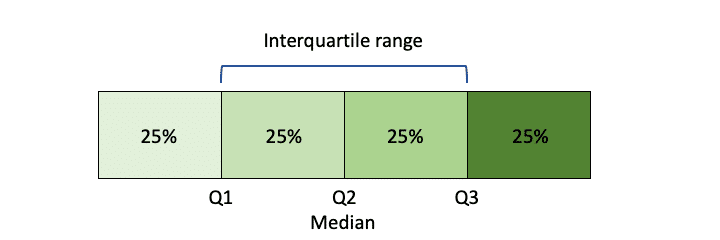
The Interquartile Range (IQR) shows how much variability exists in the middle 50% of a data set by calculating the difference between Q3 and Q1. This helps highlight where most values lie, offering a clearer picture of data spread without being skewed by extreme values or outliers.
Global web icon
scribbr.com
https://www.scribbr.com/statistics/interquartile-r…
How to Find Interquartile Range (IQR) | Calculator & Examples
The interquartile range (IQR) contains the second and third quartiles, or the middle half of your data set. Whereas the range gives you the spread of the whole data set, the interquartile range gives you the range of the middle half of a data set. When is the interquartile range useful?
Global web icon
thirdspacelearning.com
https://thirdspacelearning.com/us/math-resources/t…
Interquartile Range- Math Steps, Examples & Questions
The interquartile range (I Q R) (I QR) is a descriptive statistic and measures the variability or spread of the data. The larger the interquartile range, the wider the spread of the central 50 % 50% of data.
Global web icon
math.net
https://www.math.net/interquartile-range
Interquartile range - Math.net
In statistics, the interquartile range (IQR) is a measure of how spread out the data is. It is equal to the difference between the 75th and 25th percentiles, referred to as the third (Q3) and first quartiles (Q1), respectively.
Global web icon
thestatscalculator.com
https://thestatscalculator.com/glossary/interquart…
Interquartile Range (IQR) - Definition and Explanation | TheStatsCalculator
Definition The interquartile range (IQR) measures statistical dispersion by quantifying the spread of the middle 50% of data. It is calculated as Q3 − Q1. Because it ignores the lowest and highest quartiles, IQR is robust to outliers and is frequently paired with the median.